
For health departments and social health organizations · HAI
All of the municipality’s home care programs, coordinated in HAI.
HAI coordinates the care plan, the teams’ schedule and the record of each visit through the professional’s app. A visit that did not happen becomes a pending item with an owner, and whoever coordinates sees the same day what each team did at each home.
- Melhor em Casa
- Padi
- Palliative care
- Rehabilitation
- Municipal programs
- Works alongside e-SUS APS
Melhor em Casa is the Ministry of Health’s home care program within Brazil’s public health system (SUS). Padi is the federal home care program for older people. OSS (organizações sociais de saúde) are social health organizations that run public health services under a management contract with the health department. e-SUS APS is the Ministry’s primary care information system.
- Health departmentThe whole network, the same day.All teams and programs side by side, with what was planned, done and pending.For the health department
- Social health organizationThe management contract target, shown visit by visit.For those who run home care under a management contract with the department.For the social organization
What is at stake
Transfers, targets and records: the rule is the Ministry’s. The routine is the coordinator’s.
Each federal home care program ties the transfer of funds to production records and to targets per team. Whoever coordinates needs to know before the reporting month closes, not after.
- Melhor em Casa3 reporting months
in a row with a failure to feed SISAB suspend the federal transfer. (Portaria GM/MS 3.005/2024 (in Portuguese) (opens in a new tab))
- Melhor em Casa6 reporting months
with no production in SISAB revoke the team’s qualification (habilitação). (Portaria GM/MS 3.005/2024 (in Portuguese) (opens in a new tab))
- Target per EMAD50 users/month
is the target for EMAD type 1 (25 for type 2), with an average stay of 30 to 60 days and discharge above 30% per month. (Portaria GM/MS 3.005/2024 (in Portuguese) (opens in a new tab))
- Coverage12 h a day, 7 days
is the minimum operation of an EMAD, including weekends and holidays. (Portaria GM/MS 3.005/2024 (in Portuguese) (opens in a new tab))
- Padi3 reporting months
with no production sent to Siaps suspend the eMulti transfer, and the Padi supplement with it. (Portaria GM/MS 9.584/2025 (in Portuguese) (opens in a new tab))
- Palliative care3 months
in a row with no production record suspend the team’s transfer; six suspensions in 24 months disqualify it. (Portaria GM/MS 10.181/2026 (in Portuguese) (opens in a new tab))
HAI does not replace the official system and does not guarantee the transfer. It shows, the same day, what each team did and what is pending, so coordination can act before the close.
All programs in one HAI
Each program, one line. All on the same screen.
In HAI, each program enters as a line of care, with its own rule, team, frequency and indicator, the same way HAI already organizes home care lines. Coordination sees them all side by side, or one at a time.
AD2Melhor em Casa
- Who it is for
- Transitional, intensified multiprofessional care.
- Team
- EMAD and EMAP.
- Frequency rule
- At least weekly visits, according to the plan.
- What coordination follows
- Users per team, visits done and pending, discharges.
AD3Melhor em Casa
- Who it is for
- More frequent care of greater complexity.
- Team
- EMAD and EMAP.
- Frequency rule
- Higher frequency, according to the plan; shifts when planned.
- What coordination follows
- Execution by professional and by shift, shifts covered.
EMAP-RRehabilitation at home
- Who it is for
- People with functional loss in rehabilitation.
- Team
- EMAP-R, at least 3 higher-education professionals.
- Frequency rule
- Minimum of 50 visits per professional per month. (Portaria GM/MS 3.005/2024 (in Portuguese) (opens in a new tab))
- What coordination follows
- Each professional’s visits in the month.
PadiOlder people
- Who it is for
- Aged 60 or over, confined to home. (Portaria GM/MS 9.584/2025 (in Portuguese) (opens in a new tab))
- Team
- eMulti linked to the Family Health strategy.
- Frequency rule
- Care plan drawn up, carried out and monitored.
- What coordination follows
- Each older person’s plan and visits.
PalliativePalliative care
- Who it is for
- Home care by Primary Care or by the SAD.
- Team
- EAACP, when linked to the SAD; EMCP for matrix support.
- Frequency rule
- Production recorded every month; three months in a row with no record suspend the transfer. (Portaria GM/MS 10.181/2026 (in Portuguese) (opens in a new tab))
- What coordination follows
- Procedures and visits of the month, by team.
MunicipalMunicipal program
- Who it is for
- Defined by the department, for example follow-up of vulnerable older people.
- Team
- Defined by the department.
- Frequency rule
- The department’s rule.
- What coordination follows
- The indicator the department defines.
Acronyms are the Ministry of Health’s: EMAD (multiprofessional home care team), EMAP and EMAP-R (support and rehabilitation support teams), eMulti (multiprofessional primary care team), EAACP (palliative care support team) and EMCP (macro-regional palliative care team), AD2 and AD3 (home care modalities by complexity), SAD (home care service), PTS (singular therapeutic plan). In HAI, each program becomes a line with its own rule, team, frequency and indicator, according to the implementation. HAI coordinates schedule, visits, pending items and operational indicators; the official record follows the network’s flow (e-SUS APS) and the official indicator follows the Ministry’s rule. Integration is assessed in each implementation. AD1 stays with Primary Care.
For the health department
The whole network, the same day.
HAI brings together the execution of all teams and programs. From the secretary to the coordinator of each program, everyone looks at the same record: what was planned, scheduled, done and pending, with an owner for each deviation.
2,733 municipalities applied to join the Padi, the federal home care program for older people, at its launch. (Ministério da Saúde, 18/06/2026 (in Portuguese) (opens in a new tab)) And the department has the duty to “oversee, control, periodically monitor, evaluate and encourage the work of the teams”. (Portaria GM/MS 3.005/2024 (in Portuguese) (opens in a new tab))
- FollowWhat is planned, scheduled, in progress or pending, by team and by program.
- CoordinateOwner and outcome of each deviation.
- CheckThe result of each team and each program.
- ControlThe same record for coordination and audit.
For the social organization that runs the management contract
The management contract target, shown visit by visit.
HAI records each home visit through the professional’s app, with time and place, and turns the record into the month’s picture by team and by professional. The organization shows the department what each team did, without building a spreadsheet at month end.
- FrequencyOnce a week
is the minimum home visit under the PTS in the São Paulo municipal contract, and the minimum for AD2 care according to the Ministry. (IN CAB/SEABVES 1/2023, São Paulo (in Portuguese) (opens in a new tab)) (Nota Técnica 50/2026 (in Portuguese) (opens in a new tab))
- ProductivityTarget per professional
Municipal contracts set a minimum monthly home visit target per professional and per category. (IN CAB/SEABVES 1/2023, São Paulo (in Portuguese) (opens in a new tab))
- Volume70 to 100 patients/month
“must serve an average of”, AD2 and AD3, in the São Paulo municipal contract. (IN CAB/SEABVES 1/2023, São Paulo (in Portuguese) (opens in a new tab))
- Rehabilitation50 visits/month
is the minimum per EMAP-R professional, monitored every month. (Portaria GM/MS 3.005/2024 (in Portuguese) (opens in a new tab))
HAI does not replace the official system and does not guarantee the transfer or the target. It shows, the same day, what each professional did and what is pending, so management can correct course within the month.
What the coordination team follows
From the care plan to the recorded visit, in the same system.
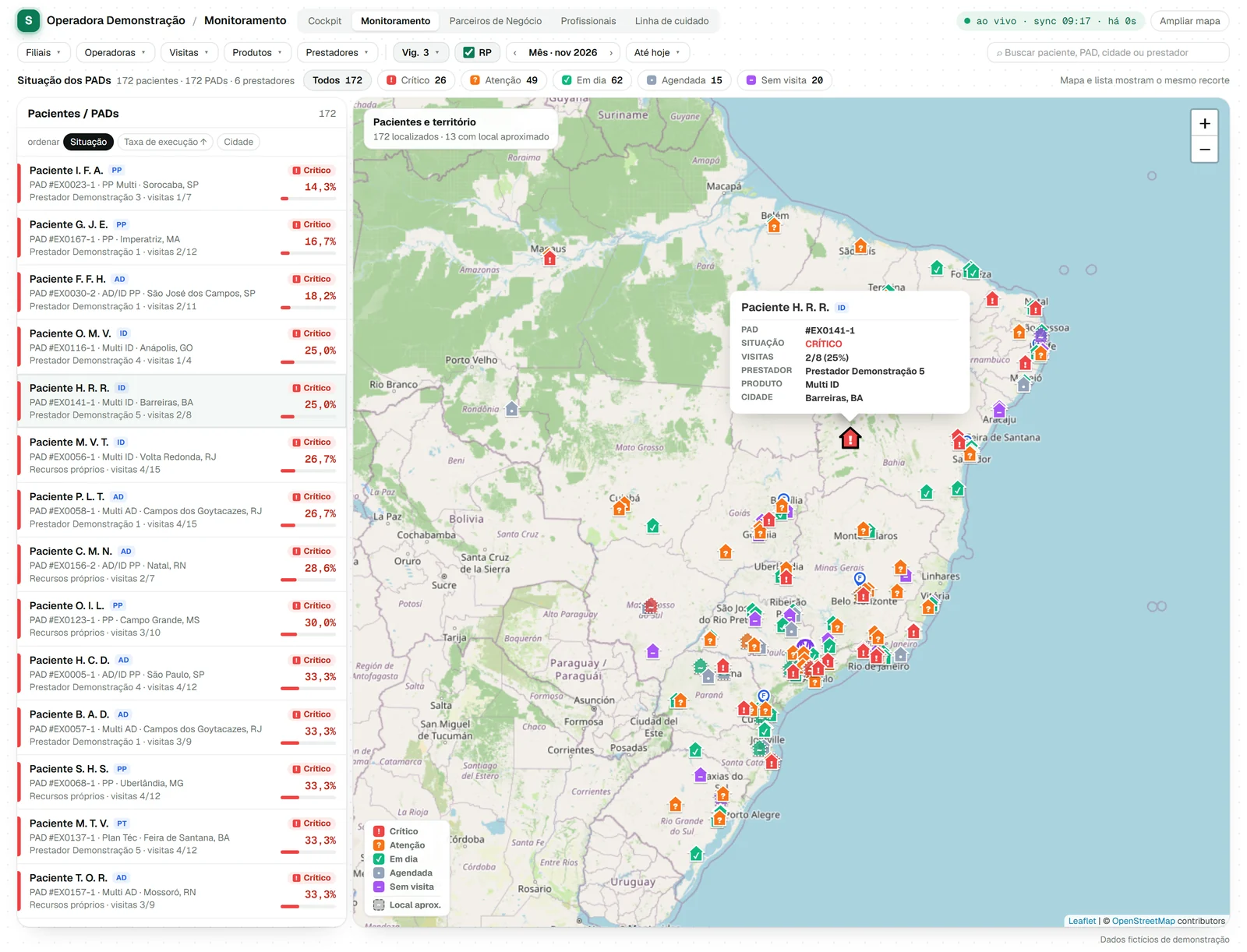
Map of the territoryEach patient on the map with the status of the plan: critical, attention, on track, scheduled, no visit. 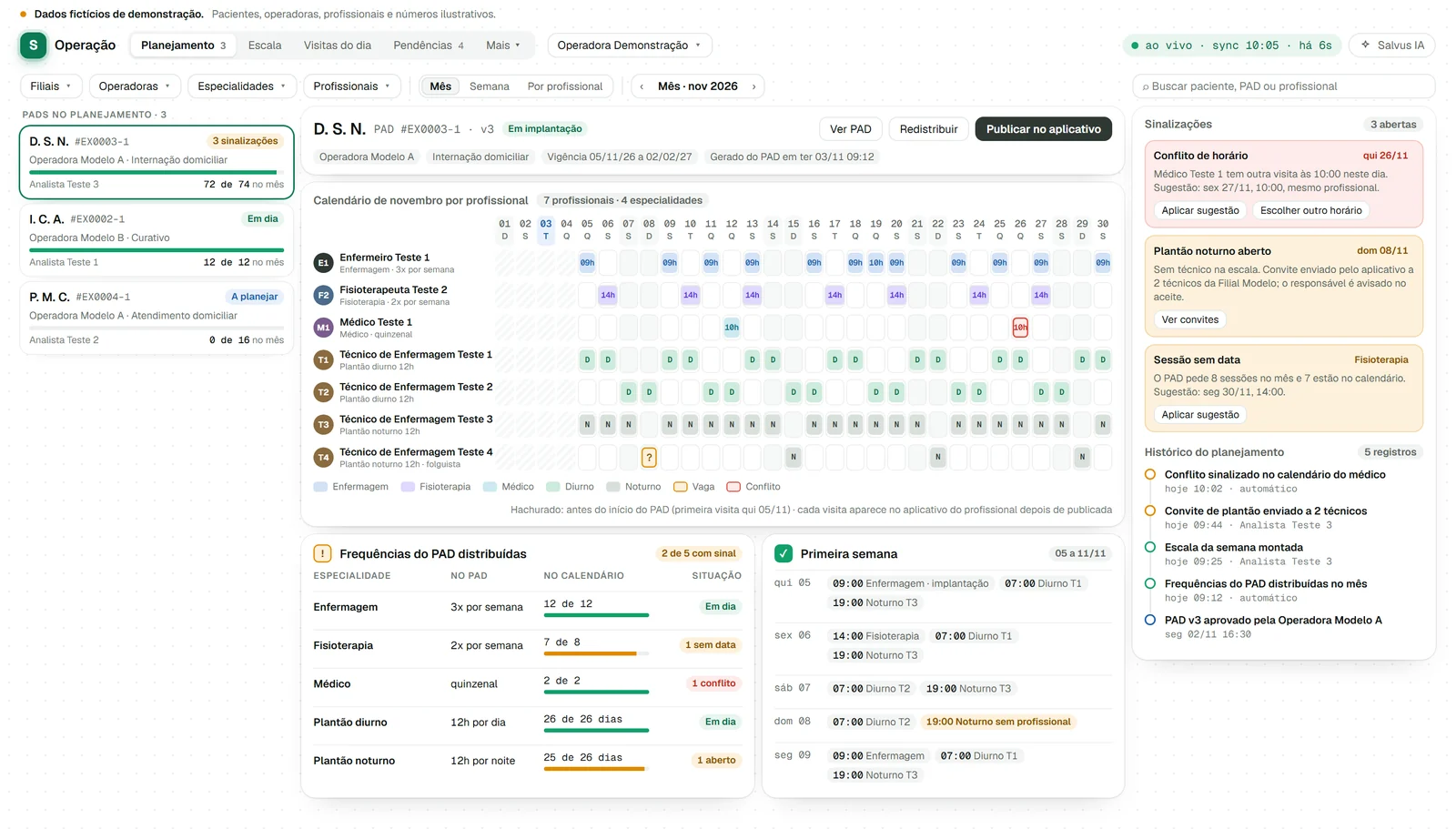
The plan becomes a scheduleEach professional’s frequency, set in the care plan, is spread across the month’s calendar. Schedule conflicts and uncovered shifts show up before they become missed visits. 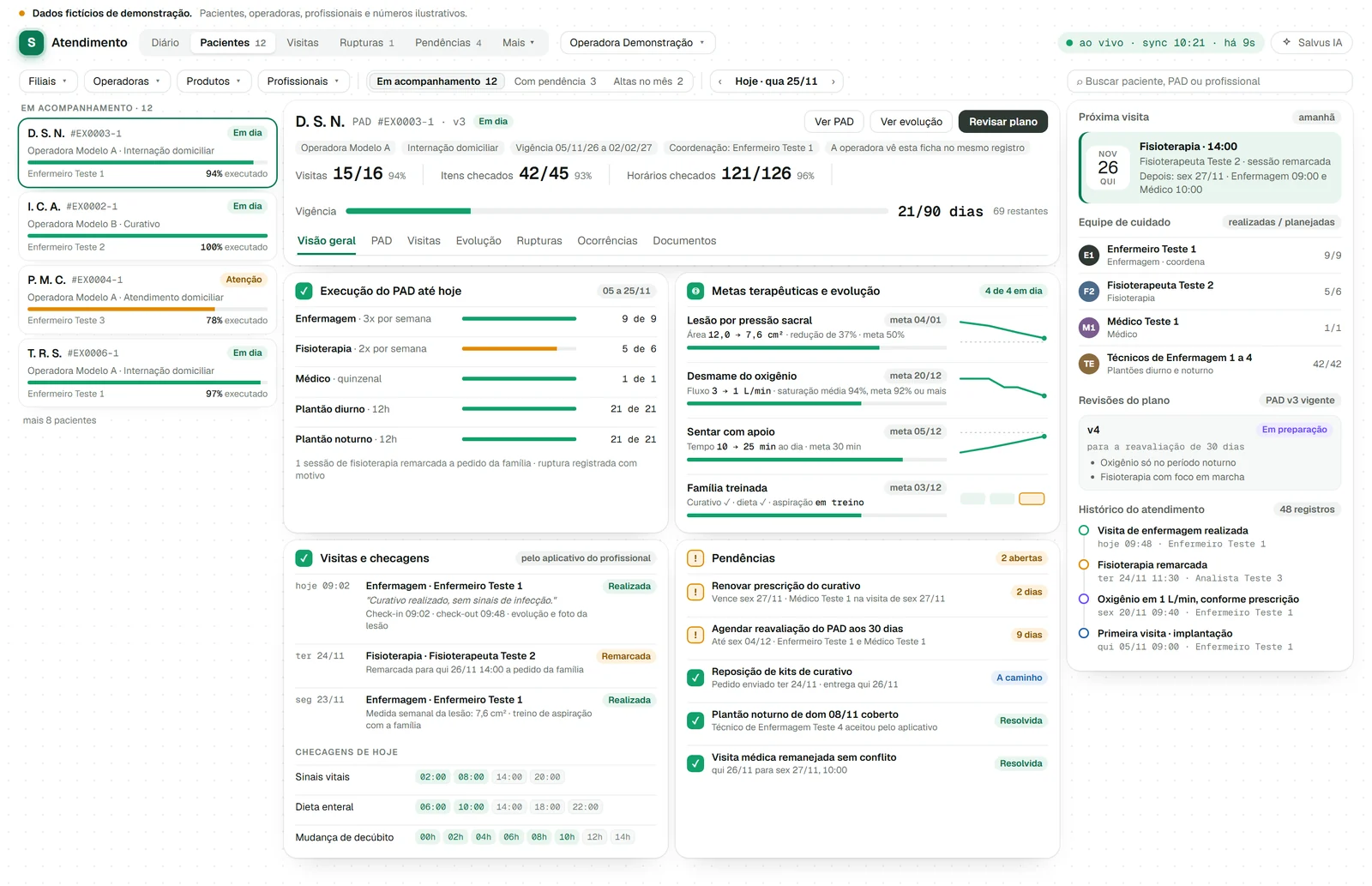
Each patient, one recordPlan execution by specialty, therapeutic goals, visits recorded in the app and pending items in the same record, for whoever coordinates and whoever audits. 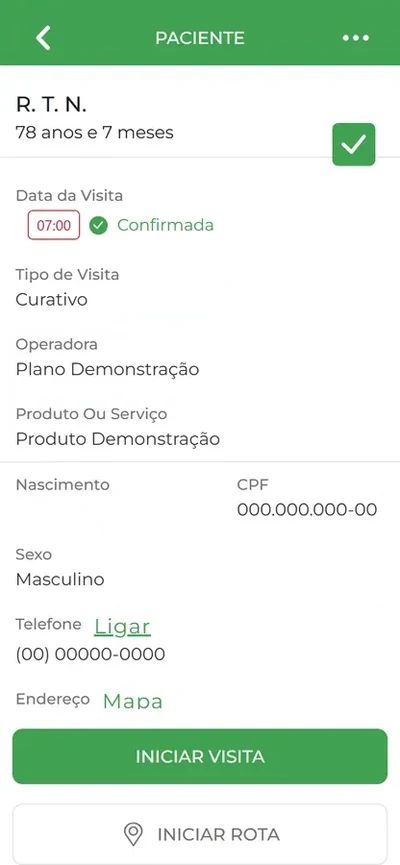
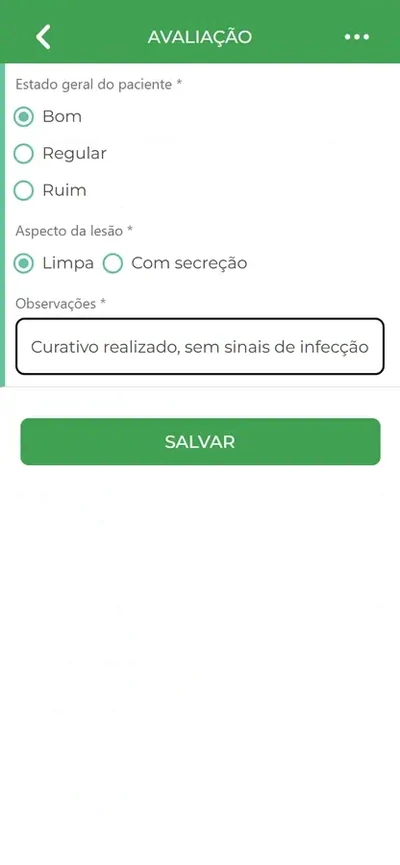
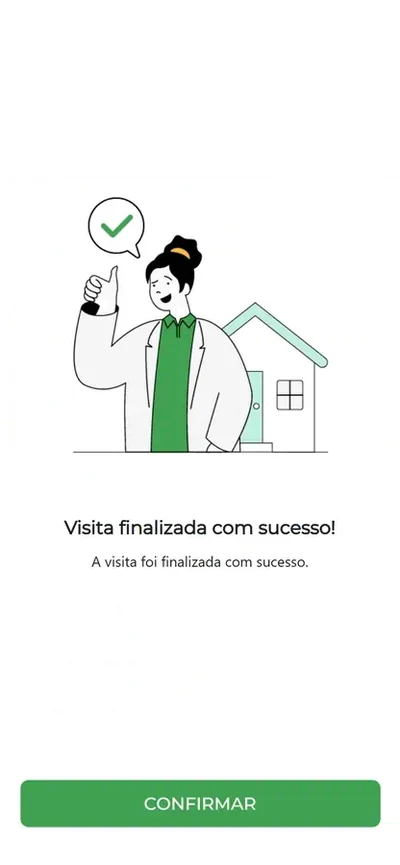
The visit is recorded at the homeThrough the app, the professional starts the visit, records the progress note and the checks, and finishes. Start and end are time-stamped.
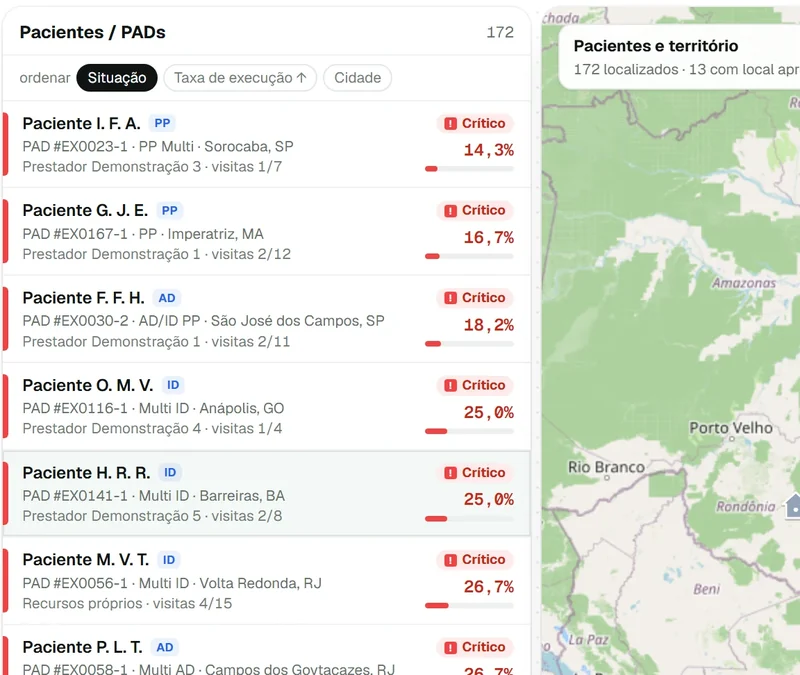
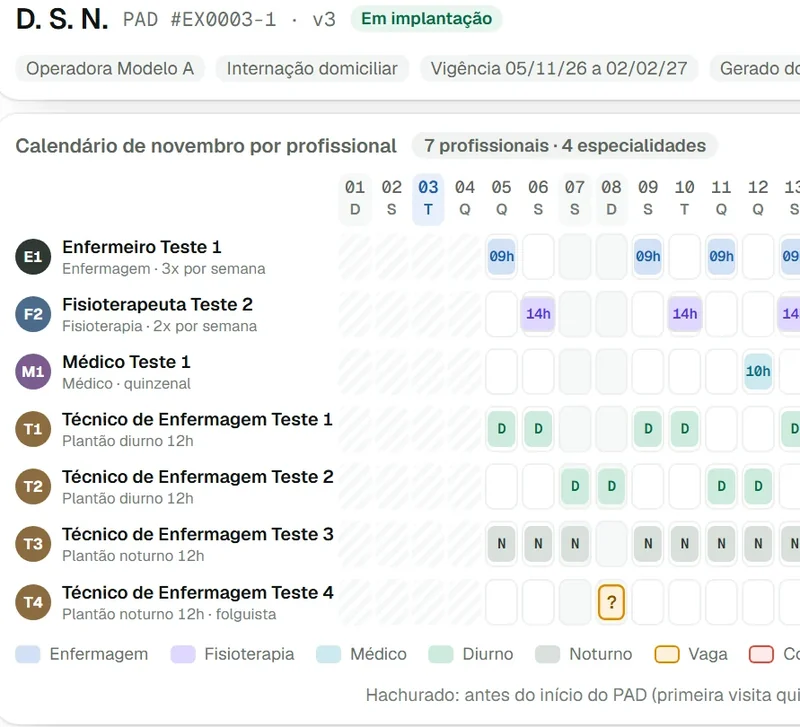
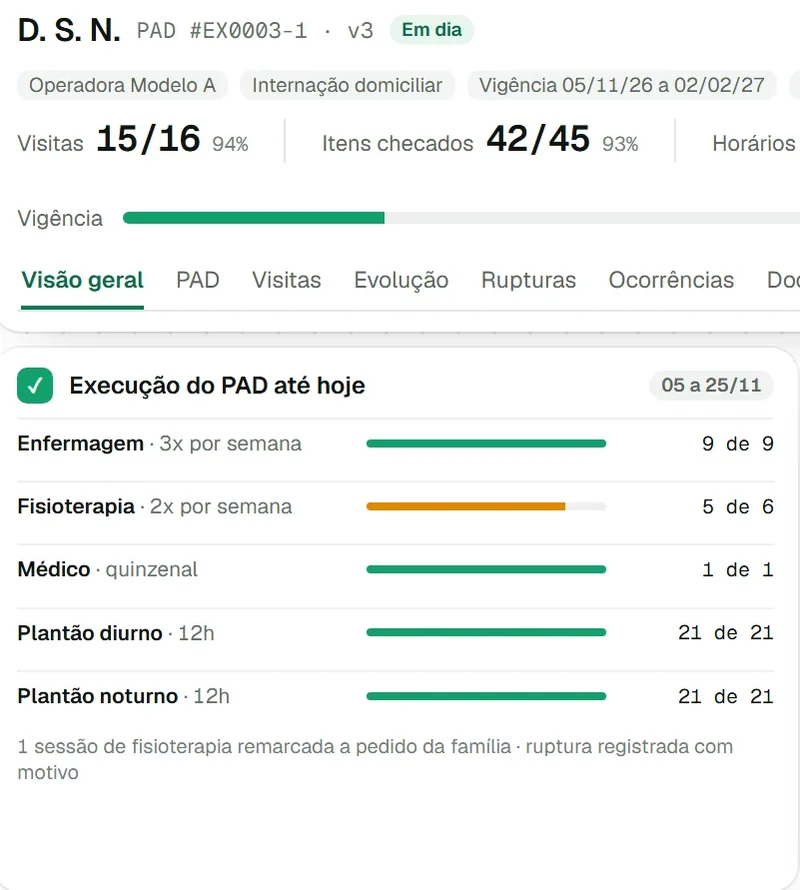
HAI screens with fictitious demonstration data. What appears in each operation follows its configuration and implementation.
In the open
What HAI is, and what it is not.
- Works alongside e-SUS APS.The official production record follows the flow set by the network. HAI coordinates schedule, visits and pending items.
- Does not replace the official system.Integration with the official systems is assessed in each implementation, in conversation with the network’s IT team.
- No promise of indicator or transfer.HAI does not calculate the Ministry’s official indicator and does not guarantee the transfer. It shows, the same day, what was done and what is pending.
- Data and security.Hosting, data region and data protection officer follow each customer’s policy. Technical and security documentation on request.
Data, access and LGPD (Brazil’s data protection law): see Security and privacy. Anything not published there is covered in the technical conversation with the agency’s IT and legal teams.
How to contract
Through the routes of Lei nº 14.133/2021, Brazil’s public procurement law.
Pregão
Bidding to contract a common service.
art. 28, IPrice registration
A price registry that allows contracting as demand arises.
arts. 78, IV, and 82Joining a registry
A body that did not take part joins another body’s registry, with justification.
art. 86, § 2ºCredenciamento
When the object can or must be contracted through accreditation.
arts. 74, IV, and 79Innovation
Contracting to comply with the Innovation Law.
art. 75, V
Procurement modalities of Lei nº 14.133/2021. (Planalto (in Portuguese) (opens in a new tab)) Understand the purchasing routes (in Portuguese). The choice belongs to the agency and its legal team. The social organization contracts under its own purchasing rules. Salvus sends the technical and security documentation for the process. We do not publish prices: the proposal is made for the design of the network.
Next step
A 45-minute conversation with your coordination team.
We reply within 1 business day. Do not send patient data by email or message.
- Map of programs and teams. Melhor em Casa, eMulti with Padi, palliative care, rehabilitation and the municipality’s own programs, or the targets the management contract requires.
- How coordination knows today that the visit happened, where the team records it and how long the month-end close takes.
- HAI demo with the visit journey, the dashboard by team and the professional’s app, using fictitious data.
- Next steps: technical and security documentation, a conversation with IT and the contracting route.
Rules are cited as worded in force in November 2026; they do not replace the official text, which is in Portuguese.